
All things trends, social media, luxury and marketing
From curated case studies to insights on strategy, creativity, and community
EDITORIAL
THE

The Best Launches Begin Before the Product Exists
A successful pre-launch marketing strategy begins long before a product is available to buy. There is a moment, just before a product ever reaches a shelf or a checkout page, where a brand has more power than it will ever have again. It is the moment before the sell. Before reviews, before comparison, before the inevitable question of whether something is worth its price. In that window, a brand is not selling a product. It is inviting people into a story.
Few recent campaigns illustrate a pre-launch marketing strategy better than Refy‘s “community hotline.” Rather than opening with a product reveal, the beauty brand invited its community to call in directly, sharing complexion concerns, current routines, and the products they wished existed. No press release, no polished unboxing, no countdown clock. Just an open line, and the quiet suggestion that whatever came next would belong to the people who showed up first.
It is a small mechanic with a large effect. By the time a product actually launches, the audience does not feel marketed to. They feel consulted. And an audience that feels consulted buys differently than an audience that simply feels targeted.
This is not a new idea dressed up in a new format. Brands have always benefited from listening before selling. What has changed is the visibility of that listening. A hotline, a comment thread or a poll, these mechanics are public by design. The audience does not simply hear the brand’s response in private; they watch the brand listen in real time, alongside everyone else. That visibility is what turns a research exercise into a marketing moment.
There is also a quieter benefit that is easy to overlook. When a brand asks a question before it has an answer, it signals confidence rather than uncertainty. It says: we do not need to pretend we already know everything about you. We are still learning, and we would like to learn it from you directly. For categories where trust is fragile: skincare, supplements, treatments, anything applied to the body or the face, that kind of humility often lands better than a brand that arrives already certain of what its customer wants.
Desire Is Not Manufactured by Scarcity Alone
For years, the standard playbook for building anticipation has leaned on scarcity: waitlists, countdowns, limited drops, the promise that something will disappear if you hesitate. It still works, and it will continue to work. Louis Vuitton’s collaboration with Supreme, New Balance’s re-release with Aimé Leon Dore, the now-familiar theatre of a countdown timer on a landing page: all of it borrows the same instinct that keeps people watching a film trailer twice.
But scarcity alone has a ceiling. It creates urgency, not investment. It can make someone want to buy something quickly, without making them feel like part of its story. What Refy’s approach adds to that formula is participation. The brand does not build anticipation by withholding information. It builds anticipation by asking a question and genuinely listening to the answer.
This is a meaningful distinction for the brands we work with. A skincare label, a longevity clinic or a boutique fitness studio, none of these need to borrow the drama of a sneaker drop to build desire. They need to borrow the intimacy of being asked, and being heard.
Scarcity also carries a risk that participation does not: fatigue. A brand can only repeat “this will sell out” so many times before the phrase stops creating urgency and starts creating suspicion. Once a customer has seen a countdown timer reset, or watched a “limited edition” reappear a month later, the mechanic loses its power, and often takes some of the brand’s credibility with it. Listening does not wear out the same way. A brand can ask its community what it wants far more often than it can convincingly claim something is about to disappear.
There is also a difference in who each approach rewards. Scarcity tends to reward the fastest customer, the one refreshing a page at midnight, the one with the quickest checkout. Participation rewards the most engaged customer: the one who leaves a comment, answers a poll, or calls in with an honest opinion. That kind of customer is usually far more valuable over time for brands built on long-term relationships than for brands focused on one-off drops.
The Sell Should Feel Like the Answer to a Conversation
The strongest pre-launch content does not announce. It converses. A behind-the-scenes formulation note. A founder asking followers what they actually struggle with. A poll, a comment thread, a voice note read aloud on a story. Each of these is a small act of listening that becomes, later, a small act of proof: we heard you, and here is what we made because of it.
This is why the most effective anticipation campaigns rarely start with the product itself. They start with the problem the product will eventually solve, discussed openly and without a hard sell attached. The reveal, when it finally comes, does not feel like an advertisement interrupting a feed. It feels like the answer to something the audience already said out loud.
We saw a small version of this same instinct play out with our own client, The Mix. A recent Instagram story asked a simple, low-stakes question: “Which instructor are you hooked with?”, paired with an open text box inviting followers to answer. The story held a 97% completion rate, meaning almost no one swiped away before it finished, a strong signal that personality-led, community-facing questions hold attention in a way that a straightforward class promotion rarely does.
It is a small format, but it points to something bigger: audiences want brands to ask them about the people behind a brand, not just the product. A question this simple can quietly shape which instructors the brand spotlights next, which classes it promotes, and which faces a community feels loyal to long before those decisions are officially announced.
What makes a mechanic like this valuable is how little it costs to run compared to what it reveals. A single story, produced in minutes, can surface which instructor the community already feels most drawn to, without a single formal survey or focus group. That is information most brands would otherwise have to guess at, or discover only after a decision has already been made and either succeeds or quietly underperforms.
The format also does something subtler: it reminds the audience that the brand is paying attention to the same details they are. Regulars already have an instructor they keep coming back for. Asking the question in public does not create that preference, it simply gives the brand permission to act on something the community was already feeling. That permission is often the difference between a decision that lands as a data-backed insight and one that feels, correctly or not, like the brand is finally recognising what its community already values.
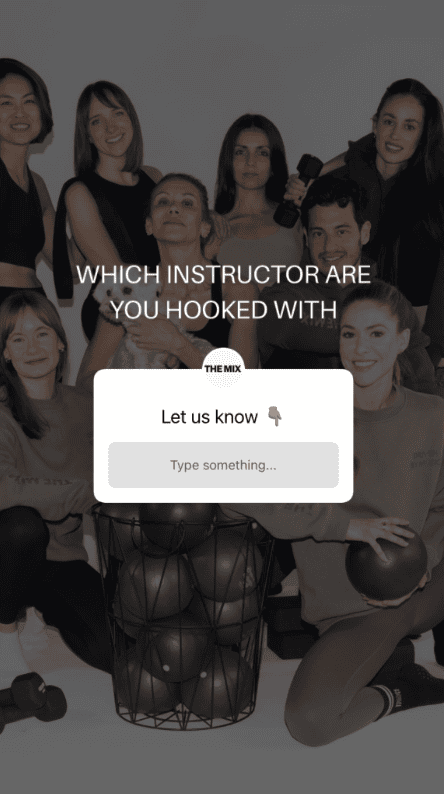
Example of The Mix’s Instagram story, July 2026
Building a Pre-Launch Marketing Strategy
A desire-before-the-sell strategy is rarely one post. It tends to move through a recognisable arc:
Every effective pre-launch marketing strategy follows a recognizable sequence. The first stage is noticing. A brand shares a problem, a frustration, or an unmet need without attaching a solution to it yet. The goal is recognition, not conversion. The audience should think, yes, that’s exactly it.
The second stage is participation. The audience is invited in: a question, a call for input, a behind-the-scenes look at early development. This is where Refy’s hotline lives, and it is the stage most brands skip entirely in favour of jumping straight to the reveal.
The third stage is anticipation. Now that the audience has been heard, the brand can begin to tease specifics: a texture, a first name, a launch window, without needing artificial urgency to hold attention. The urgency is already there, because people are waiting for something they helped shape.
The fourth stage is the reveal itself, which should feel less like a launch and more like a delivery. The audience is not meeting a stranger. They are meeting the result of a conversation they were part of.
None of these stages need to be long to be effective, and none of them require a large production budget. Noticing can happen in a single caption. Participation can happen in one story sticker. What matters is that the stages happen in order, and that each one is allowed to do its job before the brand rushes to the next. A common mistake is collapsing noticing and participation into the same post as the reveal, which flattens the arc into a single announcement and removes the very anticipation the sequence was designed to build.
It is also worth saying that this arc does not need to be reserved for major launches. A new class time, a seasonal menu change, a small collaboration, even a restock, each of these can move through the same four stages in miniature. The scale of the arc should match the scale of the news, but the logic holds regardless of size: notice the need, invite the input, tease the shape of the answer, then deliver it as something already familiar rather than something arriving cold.

Why This Matters More for Luxury and Wellness Brands
In categories built on trust like skincare, longevity, fitness, and hospitality, the relationship between brand and audience has to survive far past the first purchase. A customer choosing a wellness clinic or a boutique studio is not making an impulse decision the way they might with a limited sneaker drop. They are choosing something they will return to, again and again, and they want to feel that the brand already understands them before they arrive.
This is where community-led anticipation outperforms scarcity-led anticipation. Scarcity gets someone to click. Being heard gets someone to stay.
A successful pre-launch marketing strategy turns listening into anticipation and anticipation into loyalty. At By A Management, this is a central part of how we build social media strategy and content for our clients: not simply scheduling posts, but designing the sequence of moments: the question, the behind-the-scenes glimpse, the invitation to respond. That turns an audience into a community with a stake in what comes next.
This distinction becomes even clearer when a customer is choosing between several similar options in the same city. A boutique studio, a longevity clinic, or a skincare label rarely competes on a single unique feature; more often, it competes on how understood a prospective client feels before they have even walked through the door. A brand that has spent months publicly listening to its community arrives at that decision moment with a visible track record of paying attention. A brand that has only ever broadcast arrives with polish, but no proof.
This is also why community-led anticipation tends to compound rather than reset with every campaign. A scarcity-driven launch usually needs to invent a new reason for urgency each time: a new drop, a new deadline, a new limited run. A brand that has built a habit of listening carries that credibility forward. The audience does not need convincing that this brand pays attention; they have already seen it happen, more than once, and that history becomes part of what makes the next reveal easy to trust.
Listening Is a Strategy
It is tempting to treat community listening as a nice-to-have, something a brand does after the real strategic work of positioning, content calendars, and campaign timelines. Refy’s hotline is a useful reminder that listening is the strategic work. The comment section, the DMs, and the poll responses, these are not simply community management tasks. They are the earliest and most honest market research a brand will ever get, delivered in the audience’s own words, for free.
The brands that will stand out this autumn are unlikely to be the ones with the biggest reveal. They will be the ones whose reveal already feels familiar, because the audience helped write it.
Treating listening as strategy also changes who is responsible for it inside a brand. When community input is seen as a soft, secondary task, it tends to fall to whoever has a spare moment, and its insights rarely make it back to the people planning launches, menus, or collections. When it is treated as strategic work, the comments and replies are read with the same attention as a sales report, and the patterns that emerge, like the instructor people keep mentioning, the product people keep requesting, or the phrase that keeps showing up unprompted, start to directly shape decisions rather than sitting unused in a notifications tab.
The brands that get this right rarely make an announcement about it. There is no campaign called “we listen to our customers,” because the moment listening becomes a slogan, it starts to feel like performance again. Instead, it shows up quietly, in the small decisions that feel oddly well-timed: the instructor who finally gets a spotlight, the shade that finally gets restocked, the class that finally gets added to the schedule. The audience rarely knows exactly why it happened. They just notice that, somehow, the brand keeps giving them what they were already asking for.
At By A Management, we help luxury, wellness, and lifestyle brands design pre-launch strategies that turn listening into anticipation and anticipation into loyalty across social media strategy, content production, and community management.
Leave a Reply

– anabel, ceo & founder
Do what you love and love what you do.
Behind our articles stands a team of strategists, marketing experts, and creatives who don’t just talk about digital success – we build it every day. At By A Management, we believe in transparency, expertise, and showing our work. This editorial is your backstage pass to our thinking, our process, and our people.
By A Management is a growing boutique creative agency based in Zurich and Madrid. We specialize in social media, content creation, and strategy-led brand growth for luxury, wellness, lifestyle and fitness brands.


