
All things trends, social media, luxury and marketing
From curated case studies to insights on strategy, creativity, and community
EDITORIAL
THE

Three Seconds Decide Everything
There is a brutal, well-documented truth about short-form video: the first three seconds decide whether anyone sees the rest. Not the caption, not the music, not the call to action buried at the end. Three seconds. In that window, a viewer’s thumb is already deciding whether to keep scrolling, and no amount of polish later in the video can undo a slow opening.
This is not a reason to panic. It is a reason to get specific. A reel that stops the scroll is rarely the result of luck or a trending sound. It is the result of a handful of deliberate choices, repeated consistently, refined slightly each time. Understanding what those choices actually are, rather than treating every reel as a fresh creative gamble, is what separates content that performs by accident from content that performs by design.
Scroll through any high-performing wellness, beauty, or fitness account for long enough, and a pattern starts to repeat. The strongest openings do not begin with a logo, a slow zoom, or a voiceover explaining what is about to happen. They begin mid-motion: a hand already reaching for something, a sentence already halfway said, a result already visible before the setup is given. The viewer is dropped into the middle of an action, not warmed up for one. That single decision, starting inside the moment instead of before it, tends to do more for retention than any hook line typed across the screen.
Every reel makes a promise in its first frame, whether intentionally or not. A still shot of a product on a table promises something calm and considered. A face looking directly into the lens promises intimacy. A fast cut mid-motion promises energy. The mistake many brands make is choosing the opening frame based on what looks nicest in isolation, rather than what makes the specific promise they want the rest of the video to deliver on.
The strongest openings tend to do one of three things immediately: pose a question the viewer wants answered, show a transformation already in motion, or interrupt an expectation. A shot that begins mid-action — a hand already reaching, a door already opening, a sentence already started — pulls a viewer into a story they feel they have already missed the beginning of, which is precisely what makes them stay to catch up.
Text overlays deserve the same scrutiny as visuals. A caption that states the obvious (“New Product!”) gives a viewer nothing to resolve. A caption that creates a small gap in understanding — a partial thought, an unexpected claim, a number without context yet, gives them a reason to keep watching to close that gap.
At By A Management, this is one of the first things we work through with any clinic or wellness brand entering short-form video: not the visuals, not the editing, but the opening line. Before a single shot is planned, we start from the question of what a viewer would actually stop scrolling for, the sentence someone recognises themselves in immediately, rather than the sentence a brand wants to say about itself.
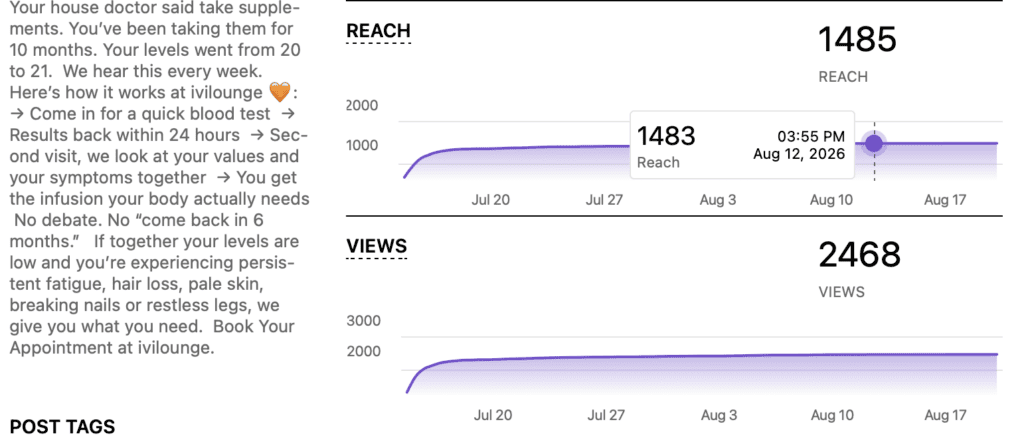
With IviLounge, that meant starting from the frustration most patients already carry into a first consultation, being told their levels are “within range” without ever actually feeling better, rather than starting from the science behind the treatment itself. A clinical category like this one has a natural pull toward leading with credentials, results, or explanations, but credibility earns trust after the hook, not during it. The first three seconds have one job only: make the viewer feel understood before they are told anything about the solution.
This is the part of content strategy that rarely shows up as a line item. It is not filming, and it is not editing. It is the work of sitting with a brand’s actual client conversations and translating the frustration underneath them into a sentence a stranger will recognise before they have any reason yet to trust the brand. For a category built on medical credibility, that translation matters even more, because the opening line has to earn attention without ever sounding like a sales pitch.
Pacing Is a Craft, Not an Accident
Once a reel earns its first three seconds, pacing determines whether it earns the next twenty. This is where many well-produced videos still lose viewers: not because the footage is bad, but because every shot lingers a beat too long. Short-form video rewards a kind of restlessness. A shot should generally end slightly before the eye is fully satisfied with it, not after, so the cut itself pulls the viewer forward.
This does not mean every reel needs frantic, whiplash editing. A slower, more editorial pace can work beautifully for luxury and wellness content, where a sense of calm is part of the brand’s positioning. The discipline is the same either way: know precisely how long each shot needs to do its job, and cut the instant it has done it. The most common editing mistake is not “too fast” or “too slow” in the abstract — it is inconsistency, where some shots overstay their welcome and others feel rushed, breaking the rhythm a viewer’s attention has settled into.
Sound design plays a larger role in pacing than most brands give it credit for. A cut that lands exactly on a beat, a breath, or a spoken word feels satisfying in a way that is hard to articulate but easy to notice. Reels that feel effortlessly “well made” have usually spent real time aligning visual cuts to audio, even when the audio is a trending sound rather than something produced in-house.



The Middle Needs a Turn, Not Just More of the Same
A common structural flaw in underperforming reels is a flat middle: the opening hooks well, then the video simply continues doing the same thing until it ends. Viewers who were curious enough to stay past the hook need a reason to stay past the midpoint too, and that reason is usually a turn, a shift in what the video is actually about.
This might be a reveal that recontextualises everything shown before it, a shift from wide shots to intimate close-ups, or a change in tone from observational to direct address, where the subject suddenly looks at the camera and speaks to the viewer. Whatever form it takes, the turn signals that the video is going somewhere, not simply continuing.
For service and treatment-based brands especially, the turn is often the moment content shifts from “here is what this looks like” to “here is what this actually does” the before becoming an after, the process becoming a result. Planning that turn deliberately, rather than hoping the footage naturally has one, is one of the simplest ways to lift a reel from pleasant to genuinely watchable.
In practice, the turn takes different shapes depending on the category. For a skincare or aesthetics brand, it is often literal: the moment a treatment result becomes visible, or the moment a founder stops narrating and simply shows the outcome. For a fitness or movement brand, it is more often a shift in intensity or intimacy, a wide shot of a full class cutting to a single instructor’s face mid-effort. For a wellness or longevity clinic, it is frequently a shift in register: from explaining a process to a patient describing, in their own words, how it changed something for them. The mechanism differs, but the function is the same. It gives the viewer a reason to keep watching that has nothing to do with the hook that got them there.
Captions Are Part of the Video, Not an Afterthought
It is tempting to treat the caption as something written after the edit is locked, a final administrative step before publishing. This undersells its role. A caption can do work the video itself cannot: add context, invite a specific kind of comment, or extend the story past where the footage ends. A reel that shows a transformation but leaves the “how” to the caption gives viewers a reason to actually read it, rather than skimming past. The captions that perform best rarely try to summarise the video. They add something adjacent to it: a small detail, a question, an admission, that makes the video feel more complete once read. This is also where a brand’s voice becomes most visible, since the visual language of a reel can only carry so much personality on its own.
The same logic applies to the first line specifically, since Instagram and TikTok both truncate captions after roughly one sentence before a viewer has to tap “more.” That first line carries almost the same weight as the video’s opening three seconds: it has to earn the tap, not just sit there as a preamble. A caption that opens with the most interesting sentence, rather than easing into it, gets read in full far more often than one that saves its best line for the end.
Captions are also where a brand can shape the kind of comment a reel receives, rather than leaving it to chance. Ending on a direct question, a mild disagreement, or an intentionally incomplete thought tends to produce replies that are actually worth reading, instead of a scroll of emojis. That matters beyond vanity metrics: a comment section with real conversation in it signals to the algorithm, and to new viewers landing on the post, that this is content worth stopping for, which is, in the end, the same problem the first three seconds were trying to solve in the first place.


Consistency Beats Perfection
It might seem like this level of granular attention to short-form video, three-second openings, cut timing, caption function, belongs to entertainment or influencer content rather than to luxury, wellness, or hospitality brands. In fact, the opposite is true. Because these categories are built on trust, precision, and an expectation of quality, sloppy pacing or a flat middle reads as a lack of care in a way it might not for a more casual brand. A reel that feels considered, frame by frame, quietly reinforces the same standards the brand claims to hold in its actual product or service.
This is also where the compounding value of working with a dedicated content team becomes clear. A single well-edited reel is a nice result. A consistent stream of reels, each built on the same disciplined rhythm (hook, pace, turn, caption), is what actually shifts how an account performs over months, not just for one viral moment.
None of this requires every post to be a flawless production. Chasing perfection on every single reel is often what causes brands to post too infrequently to build any real momentum. The brands that improve fastest are usually the ones that apply this framework loosely but consistently across a steady stream of content, rather than the ones producing one polished reel a month and hoping it carries the account.
Scroll-stopping is not a mystery, and it is not reserved for brands with the biggest production budgets. It is a repeatable practice, refined slightly with every post, built from paying close attention to what actually happens in the opening seconds, the middle, and the very last frame before someone decides whether to keep scrolling.
At By A Management, our content production work is built around exactly this kind of discipline: filming with the structure already in mind, then editing, pacing, and captioning so that every reel earns its full watch time, not once, but as a repeatable engine across the whole account.
Leave a Reply

– anabel, ceo & founder
Do what you love and love what you do.
Behind our articles stands a team of strategists, marketing experts, and creatives who don’t just talk about digital success – we build it every day. At By A Management, we believe in transparency, expertise, and showing our work. This editorial is your backstage pass to our thinking, our process, and our people.
By A Management is a growing boutique creative agency based in Zurich and Madrid. We specialize in social media, content creation, and strategy-led brand growth for luxury, wellness, lifestyle and fitness brands.


